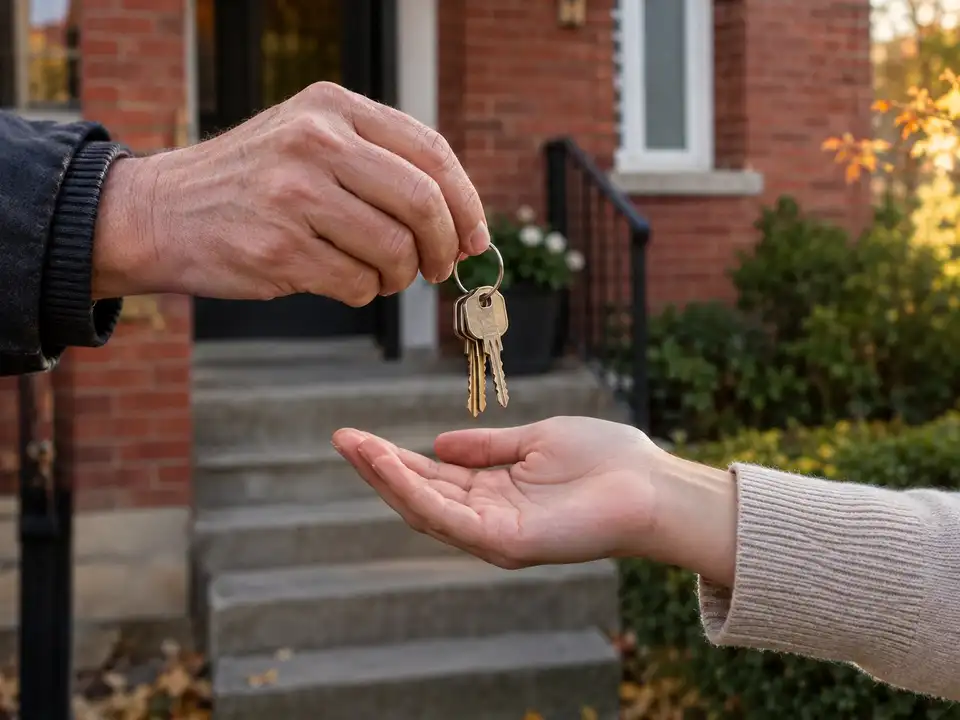
ReverseMortgageKingston.ca explains how Kingston parents 55 and older can give adult children money from the home’s value while everyone is here to see the difference it makes. An early gift like this is often called a living inheritance. A reverse mortgage is one way to pay for it, and this page covers the numbers, the family conversation and the protections for you as the parent.
Why Kingston parents think about giving now
Home prices in Kingston and area barely moved over the past year. The composite benchmark price was $542,800 in September 2026, up 0.5% from a year earlier (KAREA via CREA, September 2026). The townhouse benchmark was $403,300 that month, up 4.0%.
Those prices are a big hurdle for a young buyer who is saving while paying rent.
The City’s own Home Ownership down-payment program is closed for 2026 (City of Kingston). For some families, the parents’ home is the main place that help could come from.
Many parents would rather see the money help when a child is buying a first home or paying down debt, not years from now through a will.
How much a Kingston home could provide
Two things set the most you could qualify for: the age of the youngest owner and the home’s value. At 72, the ceiling on the highest-lending products is up to 54.81% of the home’s value. These figures are ceilings, not quotes, and each lender sets its own limits.
This ceiling includes any mortgage you have now. Whatever you still owe gets cleared first from that same amount, and you can use what’s left.
Example: a couple with a $566,800 Kingston-area home
Take an illustrative couple whose younger spouse is 72. Their detached home is valued at $566,800, the September 2026 single-family benchmark for Kingston and area (KAREA via CREA).
At 72, up to 54.81% of $566,800 comes to about $310,700. That is the most this couple could qualify for. In this example they owe nothing on the home, so nothing comes off the top.
They take $80,000: $60,000 toward their daughter’s down payment and $20,000 to clear their son’s credit card debt. They don’t borrow the other $230,700 or so, and interest is charged only on the $80,000. These amounts are only an example.
The guide to Kingston home prices shows what homes like yours are worth now.
Common ways parents use the money
A down payment on a first home
A gift toward a down payment can help a son or daughter buy sooner. Your child’s own mortgage lender decides how it treats gifted money, so your child should ask that lender early.
Clearing a child’s high-interest debt
Paying off a credit card or car loan frees up a child’s monthly budget right away. For example, $20,000 of credit card debt at 20% costs about $333 a month in interest alone.
A home for family on your own lot
Some families use the money to build a second unit, so a child or a parent can live on the same property. The page on building an additional residential unit in Kingston covers the City’s rules and its loan programs.
How to give the money
The way you give the money matters as much as the amount. Speak to your own lawyer or accountant about how to give it, whether it should be a gift or a loan, and how it fits with your will.
If you have more than one child, they can also help you think through fairness between them. That conversation is easier before the money moves than after.
Keeping the whole family in the conversation
Everything is done by email, and you never need to visit an office. Richard Hopkins, Mortgage Broker, can copy your adult children on every email, so everyone reads the same numbers. Three-way phone calls are easy to arrange too.
Every reverse mortgage lender in Canada is compared for your home. Richard’s first email sets out the amount you could get and the lenders that suit you, then asks how much you’d like to take. You get a recommendation based on your situation, even if it’s not a reverse mortgage.
Your own lawyer protects you
Before closing, you meet your own lawyer for independent legal advice (ILA). That lawyer acts only for you, not for the lender and not for your children. The mortgage can’t close without the lawyer’s signed certificate, and ILA usually costs about $800 to $1,200 in Ontario.
This step matters most when money is going to family. You get time with someone whose only job is to explain the mortgage from your side.
The only other in-person part is the appraiser’s visit to your home.
What happens to your equity over time
Interest is added to the balance, because no monthly mortgage payment is required. Home values often grow too, which can make up some or all of that interest. On average, Canadian borrowers keep about half of their equity.
The Kingston reverse mortgage calculator shows the most you could qualify for at your age, plus a chart of your home value, loan and equity over 15 years. Try a smaller amount to see how the lines change.
You can never owe more than your home is worth when the mortgage comes due. The one condition is that property tax, home insurance and upkeep stay current. All four lenders offer a version of this protection, which is typically called the no negative equity guarantee.
Costs and what stays your responsibility
When checked on October 31, 2026, advertised five-year fixed rates from the lenders were 6.23% to 6.49%. Expect one-time costs of about $2,000 to $3,500 in total: the appraisal, the lender’s set-up fee and your lawyer. The guide to reverse mortgage cost in Kingston lists each item.
Richard charges you nothing; the lender pays the brokerage once the mortgage funds. Property tax, home insurance and upkeep remain yours.
A smaller home is another way to free up money for family. The guide to downsizing in Kingston sets out those costs, and condo owners can read about reverse mortgages on Kingston condos. The ten-question reverse mortgage assessment is a quick way to check whether this route suits you.
What Richard Hopkins handles for you
- Estimates how much your home could provide for a family gift
- Compares every reverse mortgage lender in Canada for your home
- Sends, by email, the best deal for your goals once every lender is compared
- Copies your adult children on every email, if you want them included
- Helps you decide what to take now and what to keep for later
- Points you to a 15-year view of home value, loan and equity
- Explains the independent legal advice that protects you as the parent
- Follows each step until the money reaches your bank account
Kingston guides that go deeper
- Kingston Home Prices in 2026 and What They Mean for a Reverse Mortgage
- What Does a Reverse Mortgage Cost in Kingston?
- Downsizing in Kingston: What Selling and Moving Really Cost
Sources
Figures checked October 16, 2026.