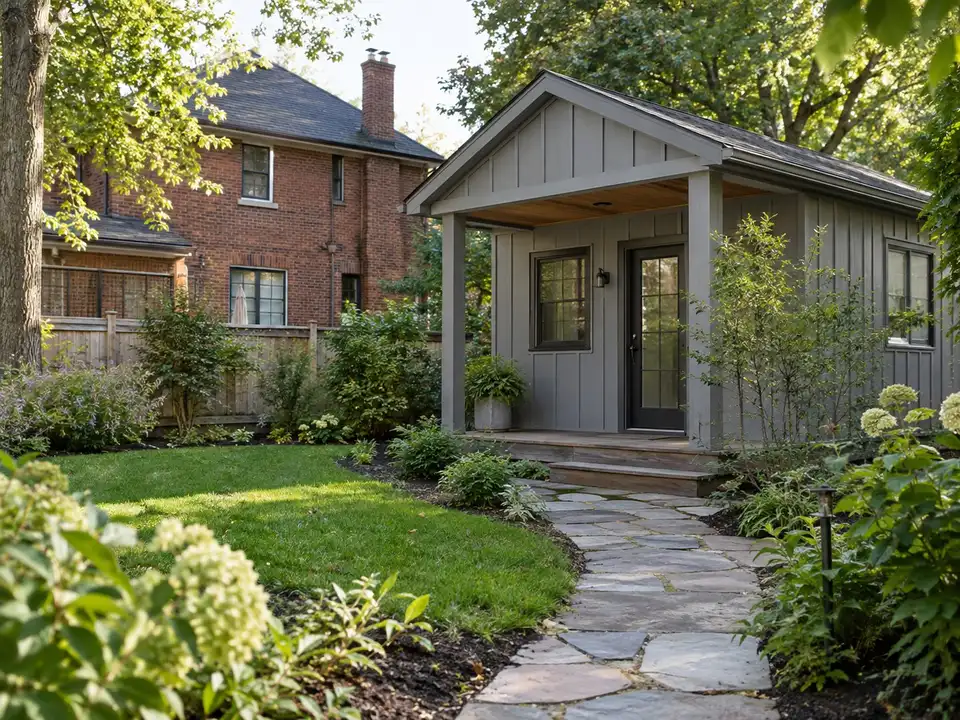
ReverseMortgageKingston.ca shows Kingston homeowners 55 and older how to pay for an additional residential unit (ARU) from the value of their home. An ARU is a second, self-contained home on your property. It can be inside the house, such as a basement apartment, or a separate building in the yard, often called a garden suite.
Families build them for different reasons. A unit can give an aging parent a place close by, give an adult child a first home, house a live-in caregiver, or bring in rent each month.
Where Kingston allows a second unit
The City of Kingston allows ARUs on most properties, but not on rural ones (City of Kingston). The page on rural Kingston covers reverse mortgages on country homes.
Properties where a unit is not allowed
A few other kinds of property are also excluded by the City:
- Land the City identifies as Loughborough Lake
- Basements and cellars in sewer surcharging areas, and land with sewer capacity limits
- Lots that already have two or more units, a garden suite or a boarding house
- Land with natural hazards
Size, parking and plans
The second unit can’t have more floor area than the main home. At least one parking space is needed, and spaces can be tandem, meaning one car parks behind the other.
The City offers pre-reviewed plans for detached ARUs. Starting from one of these means the design has already been through a City review.
The City’s ARU Incentive Programs
Kingston’s ARU Incentive Programs use federal Housing Accelerator Fund money to help owners build affordable units (City of Kingston, August 2024; program page). The main amounts are below.
| Incentive | Amount | Type |
|---|---|---|
| Detached ARU | Lesser of 50% of cost or $40,000 | Forgivable loan |
| Interior ARU, such as a basement | Lesser of 50% of cost or $30,000 | Forgivable loan |
| Accessibility top-up | $5,000 | Grant |
The conditions that come with the money
The unit must stay affordable for five years. After that, the loan can be forgiven; if the terms stop being met sooner, only 20% is forgiven for each year they were met. Rent, including utilities, is capped in 2026 at $1,353 a month for a one-bedroom and $1,588 for a two-bedroom. Tenant household income limits range from $43,000 to $65,000.
Family members are eligible tenants. Only one funded unit is allowed per property.
Where the program stands in October 2026
New applications go onto a waitlist. Only projects with a building permit issued by December 1, 2026 are being considered, and funding is not guaranteed. Check with the City before you count on this money.
The City’s loan is a second mortgage
Loans of $5,000 or more under the program are secured by a second mortgage on your home. This matters if you also plan to use a reverse mortgage.
The City registers its loan behind the first mortgage, and a reverse mortgage would be that first mortgage. Each lender decides whether it accepts a City loan behind it. Tell Richard Hopkins, Mortgage Broker, about any City loan, whether approved, applied for or waitlisted, before an application goes to a lender.
A federal tax credit for a suite for a relative
A refundable federal credit, the Multigenerational Home Renovation Tax Credit, is worth the lowest federal tax rate (14% for 2026) on up to $50,000 of eligible costs, or up to $7,000, when you create a self-contained secondary unit for a relative 65 or older (Canada Revenue Agency). An adult relative who qualifies for the disability tax credit can count too.
The credit can be claimed once for each qualifying person. Ask your accountant whether your project fits before you build.
Paying for the build with a reverse mortgage
Every reverse mortgage lender in Canada is weighed for your property. Richard’s first email gives the amount you could get and names the lenders that fit, then asks what you’d like to borrow for the build. Everything is done by email, and family members who will live in the unit can be copied on every message.
An illustrative example on a $566,800 home
Take an illustrative homeowner, aged 70, whose detached home is valued at $566,800. That is the September 2026 single-family benchmark for Kingston and area (KAREA via CREA, September 2026). At 70, she could qualify for up to 52.85% of that value, about $299,600 at most.
She still owes $40,000 on her mortgage, and that is paid off first from the same money. About $259,600 is left. Her builder quotes $180,000 for a garden suite. This amount is only an example.
She takes $180,000 and doesn’t borrow the remaining $79,600 or so. Interest is charged only on the $180,000. You can try your own figures in the Kingston reverse mortgage calculator.
Tell the lender about the plan
The appraiser sets a value on the home as it stands when they visit. A unit that’s built later isn’t counted in that first value.
Lenders only lend on the home you live in. Tell Richard who will live in each unit, and whether any part will be rented, at the very start.
Costs, payments and what stays yours
On October 31, 2026, the lenders advertised five-year fixed rates from 6.23% to 6.49%. Setting up the mortgage costs about $2,000 to $3,500 once: an appraisal, the lender’s set-up fee and independent legal advice from a lawyer you choose. The guide to reverse mortgage cost in Kingston lists each item.
There’s no charge from Richard, because the lender pays the brokerage after funding. No monthly mortgage payment is required, but property tax, home insurance and upkeep remain yours. The guide to Kingston property tax help for seniors covers the City’s tax programs.
Interest is added to the balance over time. A finished unit may add to what the property is worth, and home values often grow, which can make up some or all of the interest. The guide to Kingston home prices shows recent values.
You can never owe more than your home is worth when the mortgage comes due, as long as taxes, insurance and upkeep are kept up. This is typically called the no negative equity guarantee.
If the unit is for a son or daughter, the page on giving a living inheritance in Kingston covers the family side. If it is for a caregiver, see paying for home care in Kingston. For accessibility work in the main house, the page on home repairs in Kingston may help.
What Richard Hopkins handles for you
- Estimates how much your home could put toward building a unit
- Compares every reverse mortgage lender in Canada for your property
- Sends, by email, the best deal for your plan once every lender is compared
- Asks about any City ARU loan before an application goes to a lender
- Explains who can live in each unit while the mortgage is in place
- Copies family members on every email when they will live on site
- Explains taking one amount now or drawing more as the build goes on
- Follows the appraisal, legal advice and closing through to funding
Kingston guides that go deeper
- Kingston Property Tax for Seniors: Rates, Due Dates and Help in 2026
- What Does a Reverse Mortgage Cost in Kingston?
- Kingston Home Prices in 2026 and What They Mean for a Reverse Mortgage
Sources
Figures checked October 16, 2026.